
Ask a phone case supplier for five kinds of records. Start with supplier quality-system evidence and an approved case specification that your purchase order references. Then, depending on what your order needs, ask for material traceability, test reports tied to a defined requirement, and inspection or lot-release records.
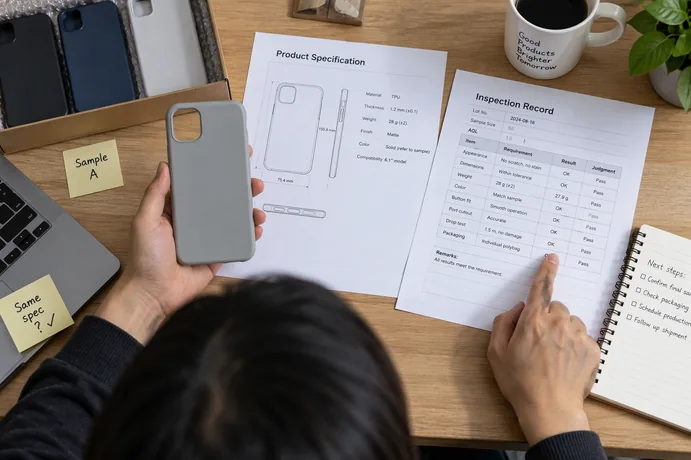
No single document proves a case is good. Phone case quality records only help when their scope matches the case, the factory site, and the order you are actually buying. Use them as linked evidence, not as blanket proof that a supplier can do anything.
Which quality records should you request?
Split your request into two layers. The first layer is supplier-level evidence and the approved specification, and it applies to almost every sourcing decision. The second layer covers material, test, and lot records. Ask for these when your case design, a stated requirement, or the level of order assurance you need calls for them.
| Record family | What it can show | What it cannot show alone |
|---|---|---|
| Quality-system and provider-control evidence | How the supplier manages its processes and sites | That a specific case or lot conforms |
| Approved case specification | The agreed reference for your product | That production matched it |
| Material identification and traceability | Which material went into the order | How the finished case performs |
| Test reports | Results for a tested sample and requirement | Results for an untested model or lot |
| Inspection or lot-release records | Checks against agreed criteria for an order | Supplier capability in general |
Read the table by its right-hand column. Each record covers a gap the others leave open, so you usually need more than one.
Supplier quality-system and provider-control evidence
Ask for current supplier-level evidence that covers the activities and the site that will make your cases. If the supplier offers a certificate, note who issued it, the organization it names, its scope, and the site it covers. Also ask how the supplier controls its own subcontractors and material vendors.
This is qualification evidence. It helps you decide whether the supplier is worth working with, but it does not prove that a particular order conforms. ISO 9001 Auditing Practices Group guidance on external providers describes several checks: keeping approved-provider information up to date, monitoring supplier performance, and carrying out the activities needed to make sure specified requirements are met. It also cautions that placing a provider on an approved list because it is registered to a quality standard may not be enough, and that the scope of that registration should be reviewed. The paper says it is educational guidance and has not been endorsed by ISO, ISO/TC 176, or IAF. Treat it as a useful model, not a binding rule.
Approved case specification and purchase-order reference
Ask for the approved specification for your case. It is the reference point for material, configuration, finish, and any other requirements you agreed on. Then check that your purchase order points to that same specification and revision.
The same APG guidance suggests confirming that the specification quoted in a purchase order matches the design specification, and checking whether the specification was approved before the order was confirmed. For phone cases, that means the model fit, material, and custom elements on the PO should match the signed-off version. A supplier certificate cannot replace this document.
Material identification and traceability when relevant
Make this a conditional request. If material identity or consistency is part of your specification, for example a named material grade, ask for information that ties the supplied material to that requirement. Where it matters, ask for a link to the material lot or batch used in your order.
There is no single universal material certificate or traceability format for phone cases. Ask for what connects the material to your spec, and agree on the form with the supplier.
Product or material test reports for defined requirements
Ask for a test report when a specific performance or material requirement makes testing relevant. Without a defined requirement, a report has nothing to prove. For each report, ask which test was run, and on which sample or case configuration.
Look at the lab separately from the product. Laboratory competence under ISO/IEC 17025 lets labs show they operate competently and produce valid results. That supports trust in the lab’s work. It does not show that your proposed case was tested or met your requirement.
Inspection or lot-release evidence when order-level assurance is needed
If you need confidence about a specific order or lot, agree on acceptance criteria first. Then ask for inspection or release records that link to those criteria and to the order or lot.
Settle the details, such as what gets checked and how much, in your agreement with the supplier. Supplier-level documents cannot stand in for this order-level evidence.
How to check records against the proposed case, site, and order
Trace each record to the scope you need. Check four things: who issued the record and which site it covers, which case and specification revision it matches, which sample or lot it describes, and which order it ties to. A record that fails one of these checks needs an explanation before you rely on it.

Check the certificate issuer, organization, site, and scope
Compare the organization and factory named on the certificate with the supplier and site that will make your cases. A trading company may show a certificate that belongs to a different factory. A manufacturer with several plants may hold one that covers only some of them.
Read the scope carefully. Guidance on what certification scope covers says a scope of certification should identify the covered product and service types, related sites, and main operational processes such as design, manufacture, packaging, and delivery. Like the other APG papers, it is educational guidance. Matching the scope to your work shows the evidence is relevant. It does not show that your order will conform.
Then confirm the certificate’s status. ISO does not issue certificates. Certification is done by external certification bodies. For accredited certification, ISO describes two ways to verify: search the IAF CertSearch database, or contact the relevant certification body, accreditation body, or Global ACI directly. A certificate that claims ISO itself certified the supplier is a red flag.
Match the case configuration and specification revision
Compare the case model, configuration, and relevant materials described in each record with your approved specification. Pay attention to revision numbers. A test or inspection record made against an older revision may not reflect current changes to material, thickness, or custom features.
Next, check that the purchase order cites the same approved specification and revision. Flag any difference and resolve it before you treat the records as applying to your order.
Connect test and inspection records to the order or lot
For each test report, confirm three points: the test addresses your defined requirement, the sample matches your case configuration, and the report identifies that sample clearly. A strong report on a different model answers a different question.
For inspection or release records, check that they use your agreed acceptance criteria and name the applicable order or lot. Keep lab competence separate from product evidence. An ISO/IEC 17025 lab can produce valid results, but only for what it actually tested.
Resolve missing or mismatched records before relying on them
When a record is missing or does not match, ask the supplier what caused the gap. Common causes include:
- A certificate for a different site or legal entity
- A report on a different case model or configuration
- A record made against an older specification revision
- A test sample that cannot be linked to production
- Inspection evidence for a different order or lot
Then ask for matching evidence, or agree on a verification step that fits your requirement, before you rely on the record. Do not quietly accept a document for another site, case, or order as blanket proof. The fix should also fit the gap. A scope mismatch on a certificate calls for a different response than a missing lot record, and not every gap needs a new test.
FAQs
Is an ISO 9001 certificate enough to qualify a phone case supplier?
No. It is useful supplier-level evidence, but only if the issuer, organization, site, and scope match the work you are buying. Even then, it does not prove that a specific case model or lot meets your specification. Pair it with an approved specification and, where needed, test or inspection records.
Does a test report from an ISO/IEC 17025 lab mean my case passed?
Not by itself. ISO/IEC 17025 supports confidence that the lab works competently and produces valid results. You still need to confirm that the report covers your requirement, your case configuration, and an identifiable sample.
Do I need material traceability for every phone case order?
Not necessarily. It matters most when material identity or consistency is part of your agreed specification. In that case, ask for information that links the supplied material, and its lot or batch where relevant, to the spec.
How do I verify a supplier’s certificate is real?
Note the certification body named on the certificate, since ISO does not issue certificates. For accredited certification, check IAF CertSearch or contact the certification body or accreditation body directly. Then confirm that the listed scope and site match your supplier’s factory.
What should I do if the supplier’s records cover a different factory?
Ask the supplier to explain which site will make your order and to provide evidence for that site. If they cannot, agree on another verification step before you rely on the records or place the order.